
Off-grid laundry
Best Washing Machines for Off-Grid Laundry
Updated October 7, 2026 · Product availability last verified October 7, 2026

Choose by water and labor before watts. The hand-crank WonderWash is the best fit when every gallon and watt matters. The BLACK+DECKER BPWM09W is the easier automatic option when you have a faucet, a drain, and inverter headroom. The Giantex twin tub handles larger loads while letting you control every fill.
- No electrical system: choose a manual washer and plan how you will wring or spin the load.
- Limited water: the WonderWash uses much less water than the pump-style Lavario.
- Cabin or powered van: the Giantex is rated 280W washing; the BLACK+DECKER's manual gives a 120V, 15A circuit rather than a wattage, so check its label and leave inverter headroom for motor startup.
Laundry is the chore nobody plans for, and it shows up about two weeks into any off-grid stay. The short answer: if you have no power system, get the hand-crank WonderWash and never look back. If your van or cabin makes real power, a compact electric washer turns wash day into a button press. Below are the machines that cover both worlds, what they truly draw, how much water they need, and the honest labor math the listings leave out.
Quick picks
Short on time? Start here
BLACK+DECKER BPWM09W
A true automatic washer for a cabin with a faucet, a drain and inverter power.
Check Price on AmazonDecide this first
Manual or electric?
Everything on this page hangs on one question: does your setup make power, or not? A manual washer asks for your arms and a few gallons of water and nothing else, which makes it the right call for camps, new builds, bug-out kits, and anyone whose battery is spoken for. An electric portable needs inverter power while it runs (the Giantex is rated at 280 watts washing), plus a way to fill it and a place to drain it, and in exchange it does the work while you do something better with the hour. The middle path is a twin tub: electric, but you control every gallon of fill water yourself, and its draw is so modest that a small battery system shrugs it off.
The watts are friendlier than most people expect. A full-size residential washer is not van material, but the Giantex's 280 watt wash motor is a load most van-sized power stations and a healthy 2000W inverter can supply, with headroom for startup. BLACK+DECKER does not publish a wattage for the BPWM09W, so check its label before choosing an inverter. Energy per load is the real budget line, and it is small: a 15 minute twin tub wash at 280 watts is about 70 watt-hours, a number our 1000Wh power station guide puts in context. Off-grid laundry is rarely a power problem. It is a water and labor problem, which is exactly what separates the picks below.

At a glance
How the machines compare
| Machine | Power draw | Capacity | Water per load | Weight |
|---|---|---|---|---|
| None, hand crank | 5 lb dry | About 2 gal | 5.7 lb | |
| Lavario (reference only, not currently orderable) | None, hand powered | A day's clothes per load | About 10 gal (5 + 5) | About 10 lb |
| Not published; 120V, 15A circuit | 6.6 lb | 3 fill levels | 48.4 lb | |
| 280W wash, 140W spin | 18 lb wash, 8 lb spin | You fill the tub | 33.5 lb | |
| 136W | 17 lb load | None, extracts water | 15 lb |
The picks in detail
Our top portable washing machines
The Laundry Alternative WonderWash
Power: None, hand crankCapacity: 5 lb dry laundryWater: About 2 gal per load
The WonderWash has been the default answer to off-grid laundry for years, and it still earns the spot. It is a sealed drum on a crank: add warm or cold water and detergent, load the clothes, close the lid, and turn the handle. The maker describes a pressure-based design: turning the sealed drum drives detergent solution through the fabric, which is how it rates a wash at one to two minutes instead of a long scrub session. It handles five pounds of dry laundry per load, about seven to ten items, on roughly two gallons of water, and the machine itself weighs 5.7 pounds, so it lives in a cabinet and works on a tailgate, a dock, or a cabin counter. The honest trade is that there is no spin cycle, so clothes come out wet and you wring them by hand or pair it with a spin dryer, and a five pound drum means jeans and towels take multiple loads.
What we like
- Zero watts, washes a load in one to two minutes of cranking
- Sips water, about 2 gallons per load
- 5.7 lb machine that stores anywhere and needs no hookups
Worth knowing
- No spin cycle, clothes come out wet and need wringing
- 5 lb loads mean big items go one or two at a time
BLACK+DECKER BPWM09W Portable Washer
Power: 120V outlet, 15A circuitCapacity: 6.6 lb, 0.9 cu ftCycles: 5, with 3 fill levels
If your off-grid setup already makes real power, the BLACK+DECKER BPWM09W is the point where laundry stops being a chore you do and becomes a machine you start. It is a true automatic washer shrunk to a 0.9 cubic foot stainless tub: pick one of five cycles and one of three water levels, press start, and it washes, rinses, and spins a 6.6 pound load on its own. The number that matters off-grid is the draw, and BLACK+DECKER's manual does not publish one: it calls for a 120 volt outlet on a 15 amp circuit. Read the rating label on the unit you receive and size inverter output from that, with headroom for motor startup. The catches are physical: it weighs 48.4 pounds, it wants a faucet style water source through the included quick connect sink adapter plus somewhere for the drain hose to go, and it is a cold water machine, so plan the plumbing before you buy. Off-grid, the plumbing catch is pressure: the manual calls for 14 to 70 psi at the faucet, so it needs an RV water pump or a pressure tank, not a gravity jug, and the manual says never to run it on an extension cord.
What we like
- Fully automatic wash, rinse, and spin on a 120V outlet
- Stainless tub, 5 cycles, and 3 fill levels to limit water use
- Quick connect sink adapter and drain hose included
Worth knowing
- 48.4 lb and needs a water source and a drain
- Cold water only, and 6.6 lb loads are still compact
Giantex 26 lbs Twin Tub Washing Machine
Power: 280W wash, 140W spinCapacity: 18 lb wash + 8 lb spinDrain: Built-in pump
The twin tub is the work horse of off-grid laundry, and the Giantex 26 pound combo is the format at its best: an 18 pound wash tub on one side and an 8 pound spinner on the other, with simple mechanical timers, up to 15 minutes of wash and 5 of spin. Semi-automatic means you are part of the machine. You fill the tub yourself with a bucket or hose, which is a feature off-grid because you decide exactly how much water each load gets, then move the wet clothes to the spin side by hand, and the built-in pump pushes the drain water up and out even when the drain sits higher than the machine. The wash motor pulls 280 watts and the spinner 140, so a 15 minute wash works out to about 70 watt-hours, almost nothing for a battery system. The honest cons: the spin tub holds less than half of what the wash tub does, so a full wash spins in shifts, and at 33.5 pounds it is portable in the move-it-sometimes sense, not the carry-it-to-the-creek sense.
What we like
- Triple the wash capacity of the compact automatics
- You control the fill, so water use is whatever you pour in
- Tiny energy per load, about 70 Wh for a 15 minute wash
Worth knowing
- Semi-automatic, you fill it and transfer clothes to the spinner
- 8 lb spin tub means big washes spin in shifts
The Laundry Alternative Nina Soft Spin Dryer
Power: 136WSpin: 1,800 RPMCapacity: 17 lb load
The Nina Soft is not a washer, it is the upgrade that makes the manual washers on this list practical. Hand wrung clothes hold a lot of water, and on a humid day they can hang on a line for a very long time. The Nina spins up to a 17 pound load at 1,800 RPM, and the maker says three minutes removes about 90 percent of the moisture, using a 136 watt motor and no heat at all, which is why it costs almost nothing to run from a battery. Pair it with a WonderWash and you have a complete laundry system: a zero watt wash, a five minute low watt spin, and clothes that go to the line damp instead of dripping. It is its own 15 pound box to store, and it dries nothing by itself, the line still finishes the job, but it is the difference between laundry that takes an afternoon and laundry that takes a day.
What we like
- Rated for a 17 lb load, about 90% of moisture out in 3 minutes
- 136W and no heating element, trivial for a power station
- Turns a manual washer into a complete laundry system
Worth knowing
- Not a washer, it only extracts water
- One more 15 lb box to find a home for
The Lavario remains in the comparison as a reference for heavy fabric. When checked on September 29, 2026, the maker's site said ordering was not possible and its Amazon listing was out of stock, so it is not a shopping pick here.
How to choose a portable washing machine for off-grid
Start with your power reality, not the product page. No system, or a small one that the fridge already owns? Go manual, and the choice inside manual is about fabric: the WonderWash is faster and far lighter on water, while the Lavario brings the mechanical force that jeans, hoodies, and work clothes need. If your batteries and inverter have headroom, the electric machines cost you almost nothing per load to run, and the decision shifts to plumbing: the BLACK+DECKER wants a faucet style fill and a drain, while the twin tub is happy with a bucket and its own drain pump.
Then count your gallons, because off-grid the water budget usually bites before the power budget does. Two gallons per WonderWash load is in a different league from ten for the Lavario, and that gap decides the winner for anyone hauling water in containers. The electric machines sit in between, and the twin tub deserves a special mention here: because you fill it yourself, a careful wash can reuse water across loads, lightly soiled clothes first and work clothes last, which is an old trick that no automatic machine can offer.
Be honest about labor and load size, because this is where listings oversell. Every manual machine on this list is real work: cranking is light but constant, pumping a full Lavario is exercise, and wringing clothes by hand is the slowest, wettest part of the whole job. Capacities are small everywhere, five to seven pounds covers most of this list, so a family's wash week means many loads whichever machine you pick. The single biggest upgrade is not a bigger washer, it is a spin dryer, which removes the wringing entirely and cuts line time dramatically.
Finally, plan the drain before the machine arrives. Wash water has to go somewhere, and a full tub is heavy enough that you do not want to discover the problem mid-load. The Giantex pumps its own water out, even uphill into a sink or jug, the BLACK+DECKER ships with a drain hose that needs a low spot or a basin, and the manual machines simply pour, which is easiest of all but still ends with gallons of soapy greywater in your hands. Where it goes is a land and rules question, covered in the FAQ below.
Power math
Which power station runs it?
Laundry is light work for a power station once you skip the heated dryer. A spin dryer uses about 7 to 11 watt-hours a spin and a twin tub about 70 to 175 a load, so even a 1,000Wh station covers several twin-tub loads or about a hundred spins. The table counts loads from a full charge, using 85 percent of the rated capacity to allow for inverter losses.
| Machine | Energy per use | About 1,000Wh | About 2,000Wh | About 3,000Wh |
|---|---|---|---|---|
| None, hand crank | No power needed | |||
| About 7 to 11 Wh a spin | 75 to 125 spins | 150 to 250 spins | 225 to 375 spins | |
| About 16 Wh a spin | 53 spins | 106 spins | 159 spins | |
| About 70 to 175 Wh a load | 4 to 12 loads | 9 to 24 loads | 14 to 36 loads | |
| Not published | Read the rating label first. Its manual asks for a 15 amp, 120 volt circuit, which carries at most 1,800 watts. | |||
Energy is rated watts times run time, so treat it as a planning ceiling: the Nina at 3 to 5 minutes a spin, the Ninja at 3 minutes, the Giantex from one 15 minute wash up to a wash, a rinse and three spins for a full 18 pound load. None of these makers publishes a startup surge, so leave inverter headroom above the rating.
Want more spin per batch? The same maker's Ninja 3200 spin dryer takes a 22 pound load at 3,200 RPM on a 320 watt motor, against the Nina's 17 pounds at 1,800 RPM and 136 watts. It weighs 19.7 pounds and drains by gravity like the Nina, so it suits a twin tub's bigger loads or a family's wash week.
Zero products required
Drying without a dryer
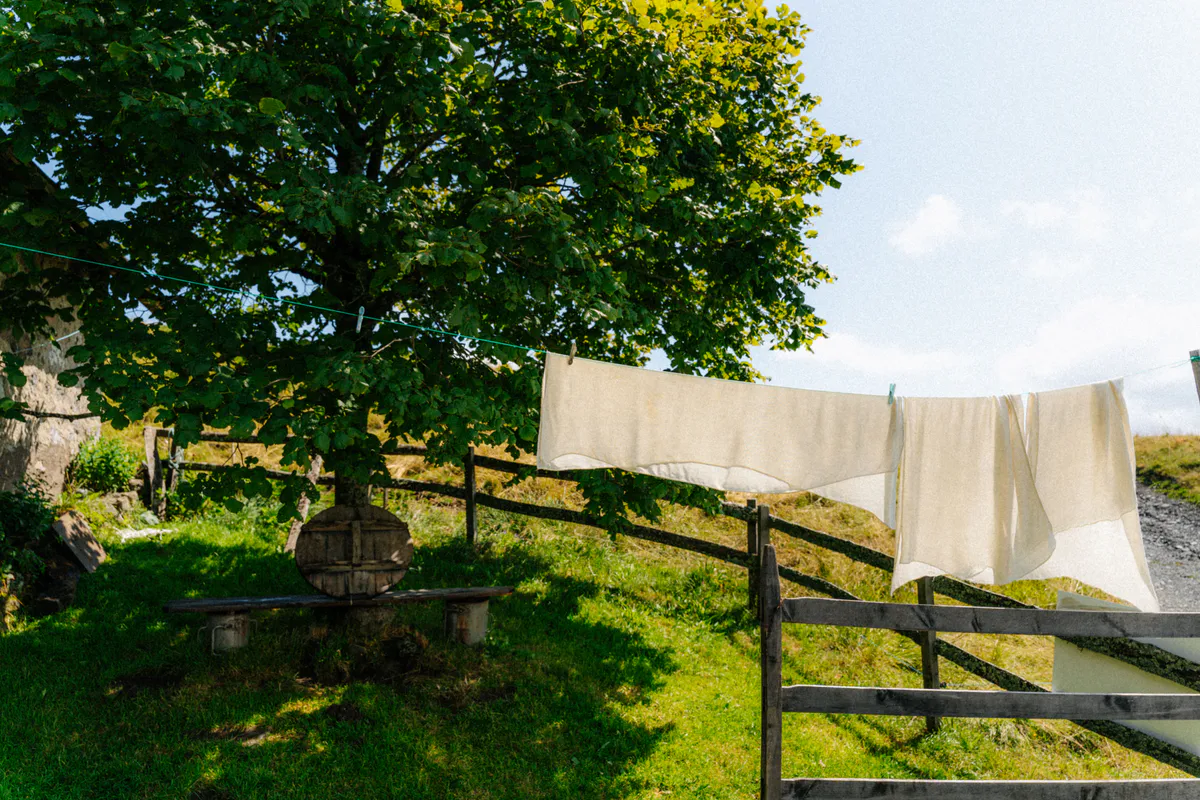
Nothing on this list dries clothes, and nothing needs to. A clothesline does the job for zero watts, and it does it well: sun and moving air will finish a properly spun load in an afternoon, and line-dried fabric lasts longer than anything tumbled in heat. The whole game is water extraction before the line. Clothes that go up dripping hang heavy and slow, while a load that has been through a spin dryer or a twin tub's spin side goes up damp and comes down dry. Rig the line where air actually moves, give clothes space instead of bunching them, and in winter dry indoors with ventilation so the moisture leaves your living space instead of condensing on it. A fifty foot line and a bag of clothespins cost almost nothing and never break, which makes them the best value purchase in this entire category.
How we checked the specifications
We compared manufacturer-listed dry-load capacity, motor input, tub arrangement, fill and drain requirements, and machine weight, rechecked against the makers and the linked Amazon listings on October 7, 2026. The BLACK+DECKER figures come from its instruction manual and Amazon listing; neither publishes a wattage. The watt-hour examples are calculations from rated input and run time, not measurements from hands-on testing.
- The Laundry Alternative: WonderWash specifications
- Giantex 26 lb twin-tub specifications
- The Laundry Alternative: Nina Soft specifications
- Our runtime calculation method for battery-powered appliances
Frequently Asked Questions
Can a portable power station run a washing machine?
The compact ones here, yes. The Giantex twin tub is rated 280 watts washing and 140 spinning, and the Nina spin dryer 136 watts. BLACK+DECKER's manual gives a 120 volt, 15 amp circuit requirement for the BPWM09W but no wattage, so read its rating label first. Any power station whose AC inverter comfortably exceeds the label can run these, though motors draw extra at startup, so give yourself headroom rather than buying an inverter that exactly matches the label. The energy per load is the easy part: a 15 minute Giantex wash at 280 watts is about 70 watt-hours, a small share of a 1,000 Wh station. Our guide to what a 1000Wh power station can run walks through that math, and the van life power station roundup covers units with enough inverter to spare.
How does a hand-crank washer clean clothes in two minutes?
Pressure. The WonderWash is a sealed drum, and the manufacturer describes a pressure-based design: cranking the closed drum drives the detergent solution through the weave of the fabric far faster than soaking can. The maker says it accepts cold or warm water, and it rates a wash at one to two minutes of turning the handle. It is the same reason the Lavario works: its pump action forces water through the clothes mechanically instead of waiting for chemistry alone. Manual washers reward technique, so do not overstuff the drum, dissolve the detergent before the clothes go in, and give heavily soiled spots a quick pre-scrub.
How much water does off-grid laundry actually take?
Less than people fear, if you pick for it. The WonderWash is rated at about two gallons per load, which is the best figure on this list and the reason it suits anyone hauling water in jugs. The Lavario's manufacturer suggests about ten gallons, five to wash and five to rinse, though you can use less for small loads. On the electric side, the BLACK+DECKER gives you three fill levels to match the load, and a twin tub like the Giantex is filled entirely by you, so each load takes exactly what you pour in. If every gallon arrives in a container, see our emergency water container roundup for the hauling side of the equation, and remember rinse water is where most of the gallons go.
How do you dry clothes without a dryer?
Spin first, then line dry. The spin is the step people skip: hand wrung clothes go to the line heavy and can hang for many hours, while clothes that have been through a 1,800 RPM spin dryer or a twin tub's spin side come out damp and finish fast in sun and wind. A clothesline costs nothing to run and works anywhere outdoors with airflow, and a folding rack does the same job on a porch or by the wood stove. Drying indoors in winter, remember all that water ends up in your air, so ventilate, especially in a small cabin or van where moisture turns into condensation on cold walls and windows.
What happens to the wash water afterward?
Laundry water is greywater, and off-grid you are usually disposing of it yourself, so plan for that before wash day. Use a biodegradable detergent, use less of it than the bottle suggests since rinsing is the expensive step when you haul water, and never dump wash water into or next to a stream, pond, or well. Scattering it on soil away from water sources is the usual practice where rules allow it, but greywater regulations vary a lot by state and county, so check what applies to your land, the same advice we give for sink and shower water in the sanitation hub. Done right, laundry is one of the easiest greywater streams to manage because the volume per load is small and you control the soap going in.