
Well pumps
Best Hand Pumps for an Existing Well
Here is the gap in most outage plans: your well is full of water, and your pump cannot touch it, because the submersible down the casing runs on grid power. A manual hand pump fixes that permanently. For a drilled well with a 4-inch or larger casing, our pick is the FloJak Plus, a stainless deep-well pump designed to sit beside your electric one. If your water sits within suction range, about 25 feet at sea level and less at altitude, a simple pitcher pump does it for far less. The depth question decides everything, so we start there.
Settle this first
Shallow or deep: the one number that decides your pump
Every hand pump on the market belongs to one of two families, and which family you need depends on a single number: your static water level, the depth at which water actually sits in your casing when nothing is pumping. Note that this is not the same as well depth. A 300-foot borehole can have water standing 40 feet from the surface.
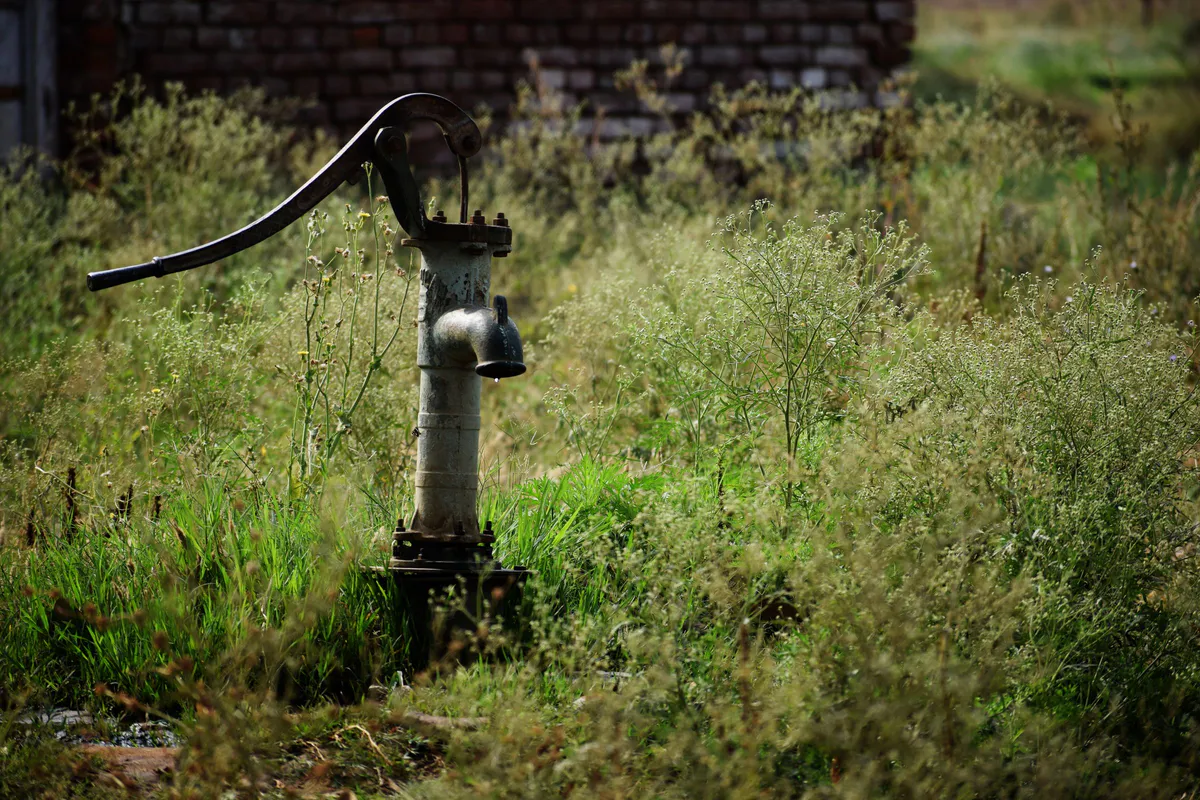
Shallow-well pumps (pitcher pumps) sit on top of the well and pull water up by suction. Atmospheric pressure caps how far suction can lift water: about 25 feet at sea level, and Simple Pump's specs put the penalty at 1 foot of lift lost per 900 feet of elevation. Simple Pump also points out that the limit counts every foot of vertical lift, so a pump mounted a few feet above the well top gives up those feet too. No design cleverness gets around it, which is why every pitcher pump on this page lists the same 25-foot figure.
Deep-well pumps cheat that limit by moving the work downhole. A piston cylinder hangs below the waterline on a string of pipe, and the handle at the surface drives it through a sucker rod, pushing water up instead of sucking it. That is how systems like the FloJak Plus reach static depths of 200 feet, and premium rod pumps go deeper still. It costs more and the install is a real project, but depth stops being a problem.
So before you shop: dig out your well report or drop a weighted string down the casing. If your lowest static level sits comfortably inside suction range at your elevation, buy a pitcher pump and pocket the difference. Beyond it, you need a deep-well system, full stop.
Match the pump to the well
Which approach fits your well
Two measurements decide it: your lowest static water level and the open space in your casing. Here is how they map to the pumps on this page, with the limit each one brings.
- Water inside suction range (25 feet at sea level, minus about 1 foot per 900 feet of elevation) on a dug well, driven well point, or cistern: a pitcher pump. The Merrill is our pick for drinking water, the VEVOR for utility water. Limits: it needs priming and its own airtight 1-1/4 inch suction pipe, it must be drained before a hard freeze, and every foot the pump sits above the water counts against the limit.
- Static water down to about 80 feet, casing 4 inches or larger, pump stays installed: the FloJak Plus 100-foot kit, with 150 and 200-foot kits for deeper water. Limits: field-glued sections and a well seal or cap to modify.
- Static water down to about 80 feet, casing as small as 2 inches or crowded by a submersible, or you would rather store the pump: the FloJak Ready 100-foot kit, with a 150-foot kit for deeper water. Limits: about 1.5 gallons per minute, and you set it up during the outage.
- Static water deeper than about 180 feet, or you want a system for the life of the homestead: Bison or Simple Pump, covered below. Limits: premium cost, and deeper settings use smaller cylinders that move less water per stroke.
The 80 and 180-foot figures come from FloJak's own sizing rule: the bottom of the pump should sit at least 20 feet below the static level and at least 10 feet above the bottom of the well. A 100-foot kit therefore covers static water to about 80 feet, and the longest 200-foot kit to about 180.
A worked sizing example
Say your well report lists a 180-foot well with a static level of 45 feet, you measure 58 feet with a weighted string in late August, and you live at 2,700 feet. Suction is out: 25 feet minus 3 feet for elevation leaves about 22 feet of lift, far short of 58. FloJak's rule wants the pump to reach at least 78 feet (58 plus 20) and stop at least 10 feet above the bottom, which a 180-foot well easily allows. A 100-foot Plus or Ready fits that window, while a 50-foot kit would hang above the water in the first dry summer. With a 4-inch or larger casing, choose between the two on permanence; with a smaller or crowded casing, the Ready is the one that fits.
Quick picks
Short on time? Start here
FloJak Plus
Stainless deep-well backup for 4 in+ casings, up to 3 GPM. The 100 ft kit covers static water to about 80 ft.
Check Price on AmazonFloJak Ready
Fully assembled coil that stores in a closet and needs under an inch of casing clearance.
Check Price on AmazonMerrill Pitcher Pump
No Lead cast iron with replaceable internals from a real well-supply maker, for water within 25 feet.
Check Price on AmazonAt a glance
How the pumps compare
| Pump | Type | Static water reached | Well fit | Build |
|---|---|---|---|---|
| Deep well | Line rated to 200 ft; 100 ft kit to about 80 ft | 4 in+ casing, seal or cap mount | Stainless + PVC | |
| Deep well | Lengths to 150 ft; 100 ft kit to about 80 ft | 2 in+ casing, under 1 in clearance | Assembled coil | |
| Shallow (suction) | 25 ft lift at sea level | 1-1/4 in suction pipe | Cast iron, No Lead, rebuildable | |
| Shallow (suction) | 25 ft lift at sea level | NPT 1-1/4 in | Coated cast iron |
The picks in detail
Our top hand pumps for an existing well
FloJak Plus 100 Foot Stainless Steel Hand Well Pump
Static water (100 ft kit): To about 80 ft; 150 and 200 ft kits go deeperOutput: Up to 3 GPMCasing: 4 in or larger
Verdict: Fits a drilled well with a 4-inch or larger casing and static water deeper than suction range, when you want a backup that stays installed. The 100-foot kit covers static water to about 80 feet. Skip it for a smaller casing or for water within suction range.
The FloJak Plus is the pump to buy if you want a deep-well backup that lives in the well year round and works the day you need it. FloJak makes it in the USA from stainless steel and premium PVC, rates the line for static water down to 200 feet, and puts output at up to 3 gallons per minute, about double its coiled Ready. It fits casings of 4 inches and larger, mounts through a well seal or cap, and is designed to sit beside your existing submersible, so the electric pump keeps doing the daily work. Through a high-pressure hose it can push water to an outdoor faucet or your bladder tank at around 30 PSI, by FloJak's figure. For winter, FloJak has you drain the above-ground parts so the water drops below a weep hole about 50 inches down. The trade-offs are real but fair: it is the top price tier of the FloJak line, and you glue the sections together in the field, which FloJak puts at 20 to 60 minutes depending on length, before the well-cap work.
What we like
- Rated up to 3 gallons per minute, double the Ready
- Designed to sit beside your existing submersible pump
- Can pressurize a bladder tank to around 30 PSI
Worth knowing
- Top price tier of the FloJak line
- Needs a 4-inch or larger casing and field gluing
FloJak Ready 100 Foot Hand Well Pump
Static water (100 ft kit): To about 80 ft; 150 ft kit goes deeperOutput: 1.5+ GPMCasing: 2 in or larger
Verdict: Fits a small or crowded casing, 2 inches and up, or a household that would rather store the pump than install it. The 100-foot kit covers static water to about 80 feet. Skip it if you need more than about 1.5 gallons per minute or want water the moment the power drops.
The Ready solves a different problem than the Plus: instead of living in the well, it lives coiled in a closet or garage until the grid goes down. It arrives fully assembled, so deployment is uncoiling it, feeding it down the casing, and pumping. Its listing gives the pipe as 7/8 inch in diameter, and FloJak says it needs less than an inch of clearance, which lets it slip in beside an existing submersible's pipe and wiring where a rigid system will not fit. FloJak sells gripper mounts for well caps, well seals, and casing clamps from 2 to 8 inches. Output is 1.5 or more gallons per minute, about half the Plus, lengths run from 25 to 150 feet, and a long coil of pipe takes some patience to manage the first time. As the no-assembly backup for a household that already has working well water, it is the easiest answer on this page.
What we like
- Fully assembled, no glue or pipe sections
- Needs less than an inch of casing clearance
- Stores compactly until an outage actually happens
Worth knowing
- About half the Plus's output, 1.5 gallons per minute
- You set it up during the outage, and a 100-foot coil takes patience
Merrill MFG PUMPHD125 Heavy Duty Cast Iron Pitcher Pump
Static water depth: 25 ft max lift (suction)Build: Cast iron, No Lead, replaceable internalsConnection: 1-1/4 in threaded base
Verdict: Fits a driven well point, dug well, or cistern with water inside suction range, and it is our shallow pick for drinking water because Merrill marks it No Lead. Skip it if your lowest static level is beyond about 25 feet at sea level, or less at altitude.
If your static water sits within suction range, you do not need pipe sections and pump rods at all. A pitcher pump on top of the well does the job, and the Merrill is the one to buy because Merrill Manufacturing, based in Storm Lake, Iowa, is a well-supply maker that also sells drive points and well parts, not a garden-decor importer. Merrill's spec sheet describes the PUMPHD125 as heavy-duty cast iron with an internal 2-3/4 inch pump cylinder, molded rubber flapper and cup seals, and replaceable internal components, so a worn seal means a part, not a new pump. The same sheet marks it No Lead, which matters if this is your drinking water. The base is tapped for 1-1/4 inch pipe, the classic setup on driven well points and shallow dug wells. The hard limit is physics: Merrill rates it for 25 feet of lift, it needs priming water to start, and an outdoor install must be drained before a hard freeze.
What we like
- Maker's spec sheet marks it No Lead
- Replaceable internal parts and rubber seals
- Simple 1-1/4 inch pipe connection
Worth knowing
- Suction only, 25 feet of lift at sea level and less at altitude
- Needs priming, and must be drained for winter outdoors
VEVOR Well Hand Pitcher Pump 25 ft
Static water depth: 25 ft max lift (suction)Build: Coated cast iron, NPT 1-1/4 inBest for: Utility water on a shallow source
Verdict: Fits a cheap backup for garden, livestock, or wash water on a shallow well point, cistern, or camp well. Skip it for drinking water unless you test what it delivers, since VEVOR makes no lead-free or drinking-water claim.
The VEVOR is the budget version of the same idea: a cast iron pitcher pump with a rust-resistant coating, rated for 25 feet of maximum lift, with a standard NPT 1-1/4 inch connection. VEVOR says it installs in 2 to 3 minutes with a screwdriver. Like any suction pump it needs priming: pour water in the top so the cup seals against the cylinder, then work the handle until the suction pipe fills. What you give up against the Merrill is pedigree and paperwork. VEVOR is a generalist import brand, some owner reviews report internal rust and seals that will not hold, and its listing makes no lead-free or drinking-water claim. As a low-cost backup for utility water on a well point, a cistern, or a shallow well at a camp, it earns its spot. For drinking water, choose the Merrill or test what this one delivers.
What we like
- Cheapest working backup on this list
- Standard 1-1/4 inch connection, quick install
- Rust-resistant coated cast iron body
Worth knowing
- No lead-free or drinking-water claim from VEVOR
- Some owners report internal rust and poor seals
Where did the FloJak Original go? We used to list FloJak's PVC Original kit as the budget deep-well pick. FloJak no longer sells it, its old product pages now redirect to the Plus and Ready, and its Amazon listing shows it as unavailable, so we removed it rather than send you searching for a retired kit.
How to buy a hand pump for your well
Start with the measurement, not the product page. Find your static water level from the well report or a weighted string, then add a margin, because static levels sink in late summer and drought years. FloJak sets the bottom of its pumps at least 20 feet below the static level and at least 10 feet above the bottom of the well, so a 60-foot static level wants a 100-foot system, not a 50. Buying the next length up costs little next to discovering your pump hangs in dry casing during the outage you bought it for.
Next, confirm the pump physically fits your well. Casing diameter and the space left beside your submersible's drop pipe and wiring are the constraints. The FloJak Plus wants a 4-inch or larger casing and mounts through a well seal or cap, while the Ready needs less than an inch of clearance, which is the difference-maker in a crowded casing. FloJak's own test is simple: lower a 10 to 20 foot length of plastic pipe with the same outside diameter as the pump you plan to install and see whether it passes. Pitcher pumps sit on their own 1-1/4 inch suction pipe instead, which is why they pair so naturally with driven well points, dug wells, and cisterns. If your backup source is a rain tank, our rainwater harvesting guide covers what it takes to make that water drinkable.
Then decide between always-installed and stored-until-needed. A permanently mounted pump like the Plus is ready the minute the lights go out and doubles as everyday off-grid infrastructure, but it commits you to the install. A coiled system like the Ready costs less commitment and hides in a closet, at the price of deploying it during the emergency itself, possibly in the rain, possibly in the dark. Be honest about which version of you will actually do that work.
Finally, respect the unglamorous details. Suction pumps need priming water before they pull, and a pump with a leather cup needs that water to soak the leather before it seals. Outdoor pitcher pumps must be drained ahead of a hard freeze or the casting can crack. Deep-well kits involve real assembly, and anything that opens your well cap should be done with clean hands and clean pipe, since dropping grit and surface bacteria down the casing is how good wells go bad. None of this is hard. All of it matters more than the brand name on the handle.
Frequently Asked Questions
Can a hand pump share the well with my electric pump?
Usually yes, and that is how the deep-well pumps here are designed to be used. FloJak says its systems fit beside the existing electric pump without removing it: the Plus needs a 4-inch or larger casing and mounts through a well seal or cap, and the Ready's 7/8-inch coil needs less than an inch of clearance. Simple Pump's compatibility chart calls 2- and 3-inch casings too small for a second pump beside a submersible, 4-inch casings often workable, and 6-inch and larger almost always fine. Measure the open space first; if a well company installed your system, your well report should list the casing diameter.
How do I find my static water level?
Start with the well report filed when your well was drilled, which usually lists static water level, well depth, and casing size; your driller or your state's well records office may have a copy. To measure it yourself, FloJak suggests lowering a weighted string with a clean washer or nut tied on, listening for the splash, and measuring the line. Take the reading after the electric pump has sat idle for a while, since static level means the level at rest, and check again in late summer, when levels drop. Buy your pump for the worst-case depth plus a margin.
My well is 300 feet deep. Do I need a 300-foot pump?
Probably not. What matters is the static water level, which is where the water sits in the casing, not how deep the borehole goes, and in many drilled wells pressure in the aquifer pushes the water far up the casing. FloJak's rule is to set the pump at least 20 feet below the lowest static level and at least 10 feet above the bottom of the well. So a 300-foot well with water standing at 60 feet needs a pump that reaches about 80 feet, which a 100-foot kit covers.
Will a cheap pitcher pump work on my drilled well?
Only if your static water is within suction range. A pitcher pump pulls water up by vacuum, and at sea level the practical limit is about 25 feet, with roughly 1 foot of lift lost for every 900 feet of elevation, and the height of the pump above the water counts against it too. If you live at 4,500 feet, plan on about 20 feet of real lift. Past that, no amount of handle pumping helps, because the limit is atmospheric pressure, not effort. Deeper water needs a deep-well pump that puts the cylinder down below the waterline.
Can I use a pitcher pump on a cistern or rain tank?
Yes, as long as the water stays within suction range of the pump, which is the same 25 feet at sea level, less at altitude, counted from the water surface up to the pump. Run an airtight 1-1/4 inch suction pipe from the pump down into the water and prime it like any pitcher pump. Collected rainwater is not safe to drink straight from the tank, so follow the treatment steps in our rainwater harvesting guide, or keep it for garden, livestock, and wash water.
What happens to a hand pump in winter?
It depends on the design. FloJak has you drain the above-ground parts so the water in the pipe drops below a weep hole about 50 inches down, and it suggests drilling a second small weep hole lower for extreme cold. Bison describes its deep-well systems as freeze proof. A pitcher pump is the opposite: it holds water in its body and suction pipe, and Simple Pump states plainly that suction pumps are not freeze proof, so an outdoor install must be drained before a hard freeze or the casting can crack. A pump inside a well house or basement avoids the problem entirely.
How much water can I realistically hand pump?
More than you might think for drinking and cooking, less than a household is used to. FloJak rates the Plus at up to 3 gallons per minute and the Ready at about 1.5, and notes that real output depends on pump depth and the person on the handle. Even at 1.5 gallons per minute, a few minutes of steady pumping covers the one gallon per person per day that Ready.gov recommends storing for drinking and sanitation. What hand pumping will not do is run showers, laundry, and irrigation, so pair the pump with stored water for comfort.
Primary sources
Specs and sizing rules come from the makers' current pages, rechecked September 29, 2026. See how we pick gear for the rest of our method.
- FloJak Plus product page
- FloJak Ready product page
- FloJak lineup comparison
- FloJak FAQ: pump length, clearance, weep hole, pressure tank
- Merrill PUMPHD125 spec sheet (PDF)
- VEVOR 25 ft pitcher pump product page
- Simple Pump shallow well suction pump: 25 ft limit and elevation rule
- Simple Pump depth ratings by cylinder
- Simple Pump well compatibility chart
- Bison Standard Deep Well Pump System
- Penn State Extension: shock chlorination of wells
- Ready.gov water storage guidance